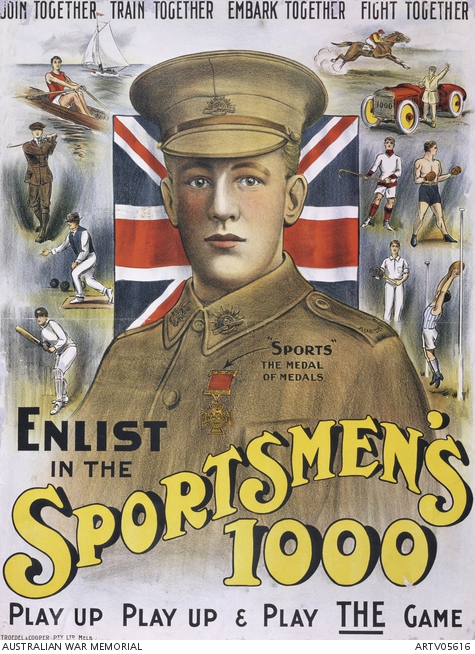
World War One is the War that shaped the current world. Germany's defeat triggered the uprise of another man who continued to form the current day. WW1 had many powerhouses in an arms race for better armies, navies and more power in general. The war lsted from the 28th of July, 1914, to the 11th of November 1918. A common problem faced by these powerhouse countires is not having enough soldiers. Propaganda was heavily relied on during this time for that reason. Many different strategies were used in many different forms.
This poster over-glorifies war in all ways possible. This poster continuously compares war to sports, labelling war as the “Sportsmen’s 1000”. The poster also shows many other sports around the soldier in the middle, these include cricket, lawn bowls, rowing, sailing, horse racing, boxing, and others. Despite Australia’s own flag being flown first on the 3rd of September 1901, this 1917 poster only includes the flag of Great Britain, revealing how much of a grip Great Britain still had on Australia. The idea of doing everything “Together” is strongly pushed in most Australian propaganda, and this one is no exception. “Together” appears 4 times on this poster, “Join Together… Train Together… Embark Together… Fight Together”. Play is also shown 3 times, “Play up Play up & Play THE Game”. This further cements the idea that war is being over-glorified to the point that it’s fun like most other games. (Photo supplied by awm.gov.au)
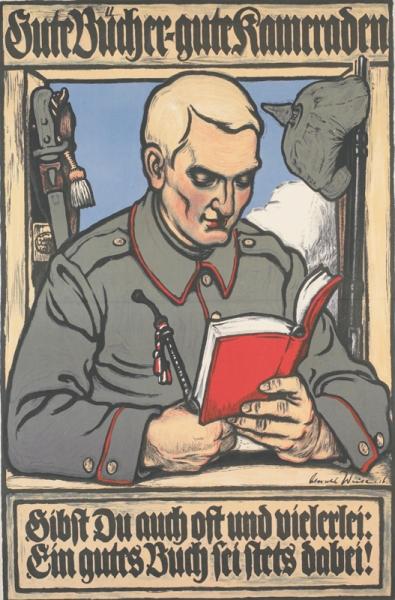
Similar to the Australian poster, this poster also pushes the idea of togetherness and comradeship. The full translation reads “Good books – good comrades. You too give often and many kinds: may a good book always be at hand!” ( www.iwm.org.uk 2024). This is an attempt to again, show war as something to be enjoyed, and that everyday life is all about giving and having no time for yourself. It also shows that in the war you’ll have items that you might not have in everyday life, like a good book. A sense of comradeship is a common theme through all propaganda posters, this one explicitly labelling the war with having “good comrades”. The poster depicts a German soldier, having hung up his helmet on his rifle and sword, smiling and reading an untitled red book. (Photo supplied by www.iwm.org.uk)
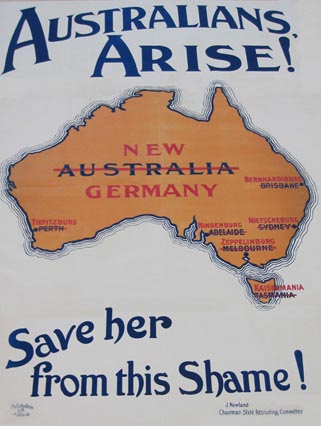
Australia has taken a different approach to this poster. Instead of an attempt to guilt people into signing up, they portray Germany as a threat. Despite the wars only going on in Europe, Australia is shown as being "New Germany". All of Australia's major towns have been crossed out and replaced with German cities, further pushing the idea of Germany invading and taking more land out of greed. The poster promotes Australians to "arise" and "protect [Australia] from this shame". "This shame" refers to being invaded and taken over. This posters main intent is to created a sense of duty in the Australians yet to enlist. (Photo supplied by abc.net.au)
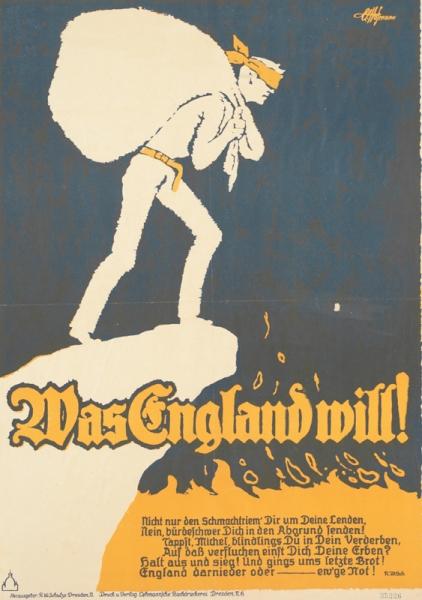
This poster, similar to Australia's depicts what the enemy would do. Unlike Australia’s, this poster depicts the enemy as much more violent. The poster shows a man, blindfolded, with a heavy sack, walking to the edge of a cliff, with a bath of fire below. The translation reads "What England wants! Not only the belt of humiliation around your loins, no, to send you weighed down into the abyss! Are you tapping, Michel, blindly towards your calamity, towards the curses of your heirs? Hold out and triumph! Even if it’s the last loaf! England down or disaster!" (www.imw.org.uk).England is depicted as not only wanting to win, but humiliate the Germans who are left. This again, tries to promote a feeling of duty or needing to protect their country and again, enlist to fight. (Photo supplied by www.imw.org.uk)
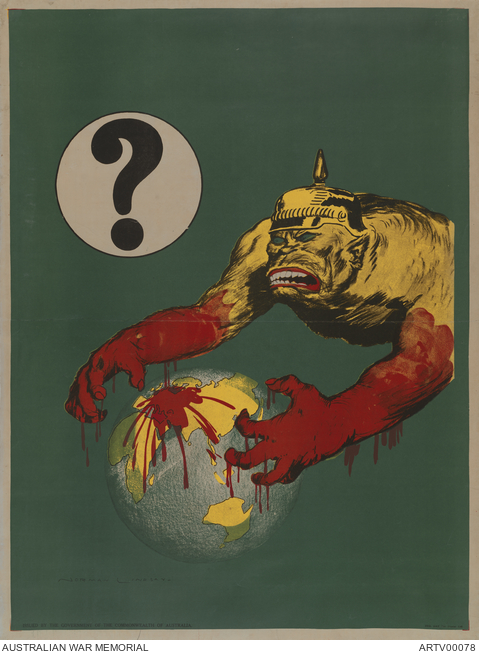
Australia had a wildly different approach when creating this poster. Germany is portrayed by an ogre or some sort monster. Blood is stained the hands of the German monster. Blood also covers Europe and is dripping down into Africa, Asia and Australia. One character is present on the poster, "?". The meaning of this question mark still has no clear answer to current day Other iterations had "The Ogre" or "German Monster" instead of the "?". The meaning of these words doesn't leave much to decipher. But the "?" could solely be the to make the reader/public to look at it longer or have to engage and think about it. This would leave a bigger impact, hopefully triggering more enlistments. The blood on the ogre and the world bellow, symbolizes that Germany is violent and will spread terror, violence, and blood accros Europe, then spreading to the rest of the world. (Photo supplied by awm.gov.au)
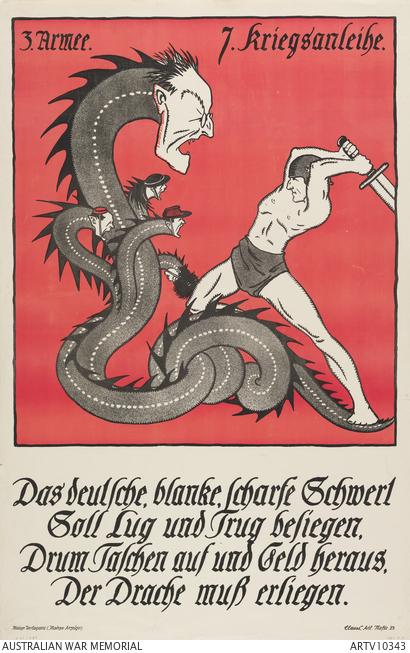
Surprisingly, Germany doesn't often include or portray the allies. This one, however, is an exception. The poster shows a German soldier, solo, only armed with a sword, attacking a 5 headed dragon. Each one of the heads represent one of the opposition countries. Applying similar strategy of showing the enemy as not human. All 5 of the heads have been distorted or deformed in some way, further creating the effect that they are enemies are some sort of monster or demon. The single soldier fighting attempts to provoke a sense of needing to help, and hold back the 5 headed beast. The poem written at the bottom states that the "German sharp sword" will prevail as long as financial aid is provided. This poster promoted "War loans" as a way to finance the ongoing war and provide equipment to soldisers in said war. (Photo supplied by awm.gov.au)